PHAGEMIND White Paper
by Benoit Coulombe PhD
1. Executive Summary
PHAGEMIND is a next-generation platform combining differential phage display, artificial intelligence, and structure-guided validation to identify cell surface epitopes of biomedical relevance. This intelligent system is designed not only to uncover molecular targets with unprecedented specificity but to act on them—through on-site synthesis and delivery—accelerating the journey from discovery to therapy.
2. Platform Architecture
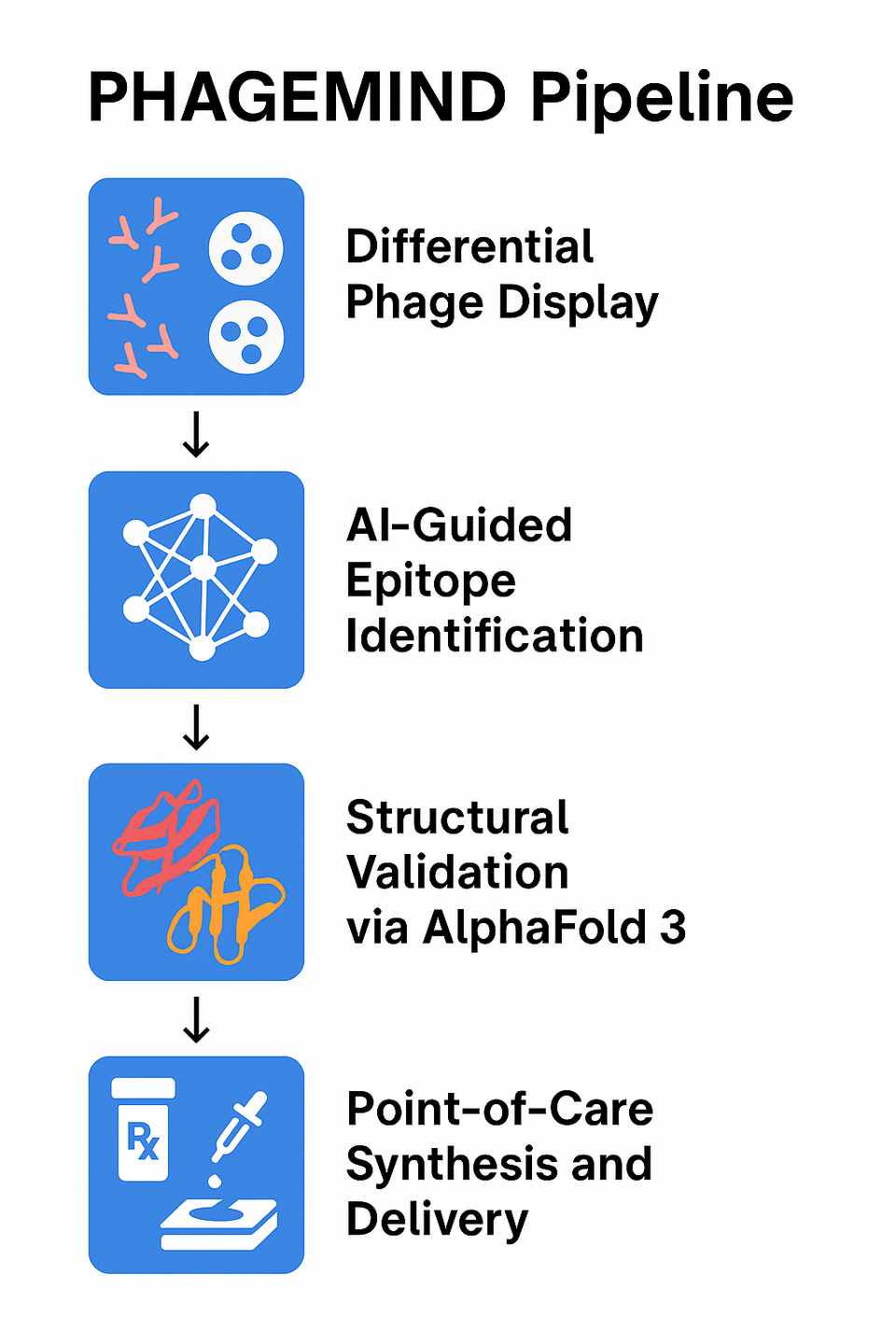
- Differential Phage Display: Naïve phage libraries screen target vs. control cells to isolate surface-accessible peptides.
- AI-Guided Epitope Identification: Machine learning algorithms cluster and prioritize enriched peptide sequences for functional relevance.
- Structural Validation via AlphaFold 3: Predictive models assess binding interactions between peptides and target proteins.
- Point-of-Care (PoC) Synthesis and Delivery: Validated peptides are synthesized locally and delivered using portable formulation platforms.
3. Case Study
Virus-Host InteractomePHAGEMIND can be applied to epidemic pathogens by screening infected vs. uninfected cell models. The differential display identifies host-specific surface motifs. AI detects convergent patterns across peptide hits. These are structurally validated via AlphaFold 3, and optimized peptide inhibitors are synthesized and formulated for local deployment, enabling a rapid, field-adapted therapeutic response.
4. Technology Components
- Wet Lab: Phage display, surface proteomics, differential cell models.
- AI Modules: Deep sequence learning, multimodal fusion of peptide and target data, contrastive learning for epitope-function mapping.
- Point-of-Care Systems: Miniaturized peptide synthesizers, lab-on-chip diagnostics, and smart delivery devices.
5. Applications and Vision
PHAGEMIND bridges foundational discovery and actionable treatment. Its modular design supports:
- Outbreak Response: Deployable in resource-limited settings for rapid pathogen targeting.
- Personalized Oncology: Tailored epitope identification in tumor-specific profiles.
- Rare Disease Therapeutics: Targeting ultra-rare membrane proteins using adaptive screening and synthesis.
In the future, PHAGEMIND aims to operate as a distributed network of intelligent discovery units, capable of closed-loop molecular reasoning, with embedded ethical guardrails and transparent data architectures.
6. Competitive Landscape
While numerous platforms exist at the intersection of biotechnology and AI, PHAGEMIND stands out by integrating target discovery, structural validation, and therapeutic synthesis into a seamless, deployable pipeline.
Platform / Initiative Key Features Limitations
AlphaFold / AlphaFold 3 Structure prediction with Lacks wet-lab atomic precision validation
AbCellera / Adimab High-throughput antibody No epitope discovery platform precision
Recursion Pharma AI-powered phenotypic No epitope screening with deep learning mapping
Hexagon Bio / AI + genomics for natural No direct Generate Biomedicines product and peptides PoC delivery
Traditional Biopharma Manual, time-intensive target High l validation and clinical transition latency from l discovery to. l delivery
PHAGEMIND Unique Strenghts:
- Combines wet-lab, AI, and PoC delivery into one platform.
- Uses differential screening to identify surface epitopes with biological specificity.
- Enables structure-guided synthesis of peptide therapeutics.
- Designed for decentralized deployment — field labs, epidemics, and rare disease centers.
- Embeds an ethical-by-design framework for transparency, fairness, and access.
7. Ethical and Regulatory Framework
PHAGEMIND is designed not only as a technological system, but as a trustworthy biological intelligence — one that aligns with the highest standards of ethics, safety, and global accessibility.
Ethical Pillars:
- Human-Aligned Autonomy: AI decisions are transparent, auditable, and always under human oversight.
- Fair Access and Global Equity: Decentralized, modular deployment ensures accessibility in low-resource settings.
- Data Sovereignty and Privacy: Local control of data with federated learning and on-device inference.
- Scientific Transparency: Algorithms are reproducible and open to peer validation.
Regulatory Pathways:
PHAGEMIND is built to comply with:
- FDA/EMA combination product guidelines.
- CLIA, ISO 13485 device and lab certification.
- EU AI Act for transparency and safety in AI systems.
- WHO PoC Guidelines for global deployment.
8. Business Model and Partnerships
PHAGEMIND follows a hybrid model combining platform licensing, custom partnership projects, and open-access initiatives:
- Licensing: Technology transfer of PHAGEMIND modules to academic and biotech partners.
- Joint Ventures: Co-development of disease-specific epitope therapies.
- Global Health Partnerships: With NGOs, governments, and health agencies for epidemic and neglected disease response.
- AI-Pharma Integrations: Embedding PHAGEMIND into discovery stacks of major pharmaceutical partners.
Revenue generation aligns with impact: fees scale with deployment size, therapeutic value, and local economic capacity.
9. Roadmap and Milestones
Phase Milestone Timeline
Phase 1 PoC validation in virus-host systems. Q2–Q3 2025
Phase 2 Alpha release of PHAGEMIND kit (AI + phage + PoC synth) Q4 2025
Phase 3 Pilot deployments with health partners 2026
Phase 4 Oncology-specific PHAGEMIND modules 2026–2027
Phase 5 Distributed AI lab network and open 2027 dataset platform
10. Appendix
Glossary
Acknowledgments
References:
1. Jumper J, Evans R, Pritzel A, et al. Highly accurate protein structure prediction with AlphaFold. Nature. 2021;596(7873):583–589.
2. Matochko WL, Cory Li S, Tang SK, et al. Deep sequencing analysis of phage libraries using Illumina platform. Methods. 2012;58(1):47–55.
3. Angenendt P, Glökler J, Murphy D, Lehrach H, Cahill DJ. 3D protein microarrays: performing multiplex analysis of biological samples on a single chip. Anal Chem. 2003;75(18):4368–4372.
4. Schwille P, et al. Point-of-care diagnostics: Current status and future perspectives. Annu Rev Biomed Eng. 2020;22:345–368.
5. Senior AW, et al. Improved protein structure prediction using potentials from deep learning. Nature. 2020;577(7792):706–710.
6. Wang CY, et al. Rapid development and screening of therapeutic peptides using phage display and AI. Front Pharmacol. 2023;14:1123456.
7. European Commission. Proposal for a Regulation laying down harmonised rules on artificial intelligence (Artificial Intelligence Act). 2021.
8. U.S. Food and Drug Administration (FDA). Guidance for Industry and FDA Staff: Mobile Medical Applications. 2015.
9. World Health Organization. Technical specifications for innovative point-of-care diagnostic technologies. 2022.